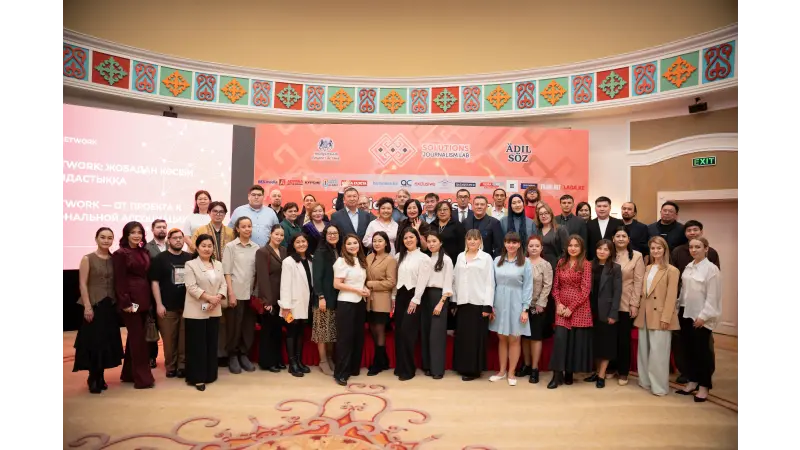
ASTANA, Kazakhstan — On 18 February 2026, the final roundtable of the Solution Journalism Lab II project took place. The project, implemented by the International Foundation for the Protection of Freedom of Speech “Adil Soz” with the support of the British Embassy, aimed to promote journalistic work that goes beyond identifying problems and instead offers concrete, evidence-based mechanisms for addressing systemic challenges.
“This marks our second major collaboration with the "Adil Soz" Foundation. Following the successful 2023 pilot, this phase has evolved from a "test of concept" into a comprehensive national program. It reflects the UK’s commitment to fostering a vibrant, independent, and high-quality media landscape in Kazakhstan,” said Her Excellency Sally Axworthy, Ambassador of the United Kingdom to the Republic of Kazakhstan.
Out of 650 applicants, 90 journalists from 19 regions of Kazakhstan were selected: 49 Kazakh-language and 41 Russian-language participants. They completed specialised training and produced their own solutions journalism pieces.
Their work addressed a wide range of pressing issues and proposed practical responses. Makpal Aibabina explored how telemedicine can improve the lives of rural residents despite shortages of medical staff and outdated hospital infrastructure. Vladimir Buryanov examined ways to reduce harmful atmospheric emissions.
Other topics included optimising ambulance services, waste management reform drawing on European experience, preservation of the Caspian and Aral water resources, protection of minors’ rights and prevention of sexual violence, and addressing inequality in rural and three-shift schools.
The solutions presented in these publications led to tangible action. Following Olga Likhogray’s article on landfill management, a new waste processing complex was installed in the city of Rudny, and large-capacity tyre recycling is scheduled to launch in the nearby village of Pertsevka by the end of autumn with support from the Zhasyl Damu programme.
After Zhania Abdibek’s publication on the challenges of three-shift schools, construction of a new 60-student school began in the settlement of Rudnichnyi in the Tekeli district of Zhetysu Region and in the village of Koksai.
These are only some of many examples demonstrating that solutions journalism delivers measurable impact.
“This is journalism that does more than inform the public — it helps identify solutions to the pressing issues that concern us all today,” said project participant Margarita Butina.
During the roundtable, the Association of Solutions Journalism was formally presented. Its mission is to develop, protect, and promote the genre of solutions journalism; safeguard journalists’ professional rights; improve the quality of journalistic content; and strengthen cooperation between journalists, civil society, and public institutions.
Work is also underway to introduce “Solutions Journalism” as an academic discipline in several leading universities across the country.
“We are concluding this phase of the project, but we are not closing it — we are moving to the next level. The establishment of the Association of Solutions Journalism marks a new stage in the development of journalism in Kazakhstan,” said Karlygash Jamankulova, President of the “Adil Soz” Foundation.
Background: Solutions journalism is an emerging global trend that focuses not only on highlighting problems and challenges but also on presenting credible, evidence-based responses. Approximately 9,000 journalists and 2,000 media outlets in 90 countries work in this genre, actively contributing to positive change in society.